
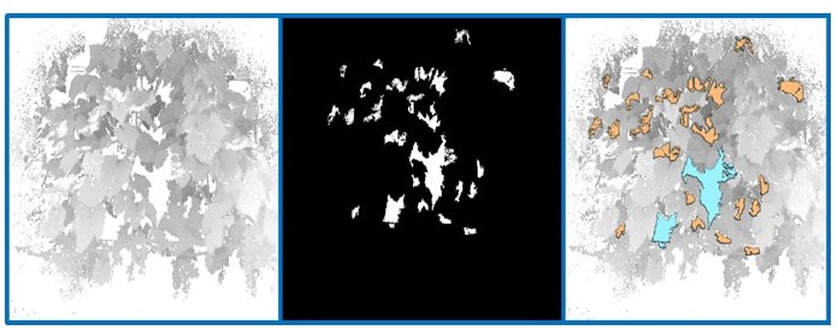
 Canopy gap detection. Left: Original canopy image constructed from ten images. Middle: Binary inversion to clearly isolate 'blobs' where the Kinect IR laser beam passes through the leaf canopy and does not reflect back. Right: Gaps colored to overlay the original image, showing both major (blue) and minor (orange) gaps. Measures of vine canopy density all have the goal of evaluating light penetration into the leaves and fruiting zone. Light that fosters growth and fruit maturation. Laser beams are a perfect analogue to natural light. Like natural light, some laser beams pass freely through openings along their path through the grapevine canopy, while others are blocked by leaves. I have always thought that one of Richard Smart’s most creative measures of canopy density and balance was “canopy gaps”. It is, in fact, a measure of how open the leaf canopy is to light penetration. If you look at a VSP canopy from the side, the “gaps” are the places where light can pass through from one side of the vine to the other, unimpeded by leaves or fruit. Or think of it as the spaces where you can see through the leaf canopy. If you can see through 30% of the leaf canopy, the vine gets a high score for being in balance. For years, I have eye-balled these canopy gaps in my vines. But I never had any idea how accurate my observations were. Using a MS Kinect LIDAR device (cost $149) and several image processing steps, Chuck Hisamoto and Kale Hedburg from Aster Labs LLC, and I built a system that provides almost a perfect measure of gaps in the grapevine canopy. Much more accurate than what the human eye can estimate or even what can be estimated by the tedious use of manual point quandrant methods. And it does it almost instantly. We also have conceived a method for automatically measuring the number of leaf layers in the canopy, another key measure of canopy density from Richard Smart. It uses the same low cost consumer LIDAR technology. We are looking for funding or investment to further pursue the implementation of that technology. Comments are closed.
|
Author
Tom Plocher, owner, Plocher Vines, LLC. Archives
February 2024
Categories
|
 RSS Feed
Proudly powered by Weebly